Celtic tattoos, anywhere

Filters
1 tattoo studio
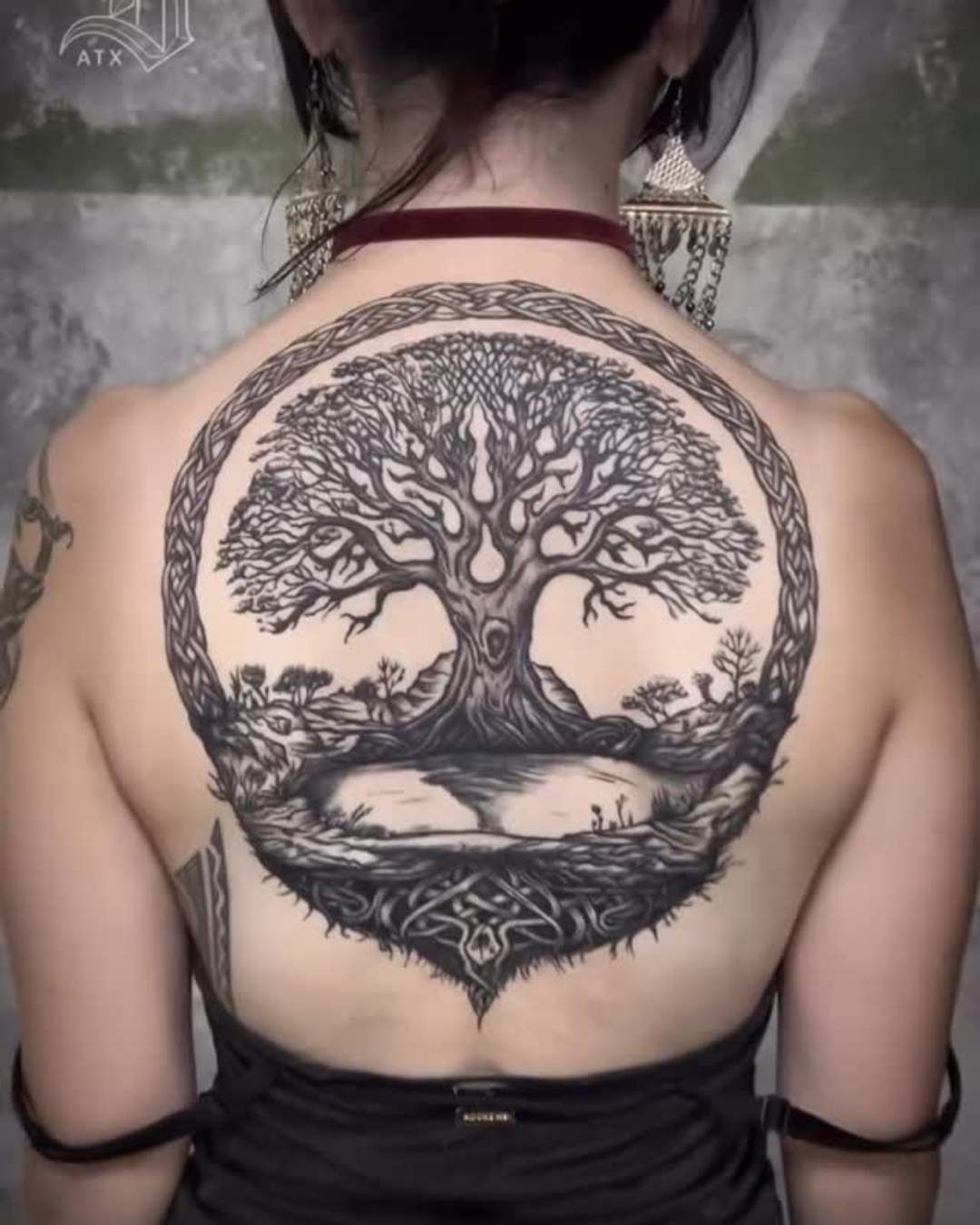
Celtic comes from Irish and Scottish insular art: endless interlace, woven knots, spirals and animals drawn out into ribbons.
On YokoFolio, pick the style Celtic and then your city, and widen the radius if the list is short. The test is simple and foolproof: follow an interlace with your finger in the photos. It should alternate over and under regularly at every crossing, never twice the same way in a row. Plenty of designs found online contain weaving mistakes; an artist who works in this style corrects them instead of tracing. In healed photos, check that the gaps between the strands are still open and the lines still even. When you contact the artist from their profile, ask what source they draw from — a manuscript, a stone cross — and, for a band, how they'll make it close around your arm.
Less than you're told. Irish and Scottish insular art is essentially decorative and religious: it adorned Gospel books, stone crosses and precious metalwork. The interlace fills space, and the spirals and triskeles are old shapes whose modern readings — three worlds, eternity, the cycle of life — came much later, often in the 20th century. Some spirals are even older than Celtic art: they were already carved on Ireland's Stone Age monuments. That takes nothing away from their beauty, but it's better to know it than to wear an invented meaning believing it's ancient. If a design matters to you because of Irish or Scottish family roots, that personal meaning is reason enough on its own.
Two cautions. The first is about sources: sheets of “Celtic designs” sold online happily mix insular art, Norse, Pictish and shapes invented in the last century. If you want an Irish or Scottish motif, ask your artist to work from a real source — a manuscript, a stone cross. The second is more serious: some symbols, particularly sun crosses and runes wrongly attached to the Celtic world, have been taken up by far-right groups; the sun cross is a plain cross inside a circle, unlike the carved high crosses. Read up on what you're wearing. And if you want words in Irish, Scottish Gaelic or ogham, the early Irish alphabet carved on stones, have them checked by someone who reads them, not by an online translator.
Both weave interlace, so look at what the weaving carries. Nordic brings in Norse motifs — runes, Thor's hammer, Yggdrasil, ravens, wolves, the valknut — and a bestiary of beasts that bite, stretch and knot themselves, drawn in the manner of Viking-age styles such as Urnes or Jelling. Celtic keeps to knots, spirals, triskeles, crosses and animals drawn out into ribbons, woven evenly over and under. Color can help too: touches of the ochre, vermilion and deep blue of illuminated manuscripts point to Celtic, while Nordic is most often worked in black, with greys for relief. If it's interlace, spirals or crosses with no rune and no Norse motif, it's Celtic.