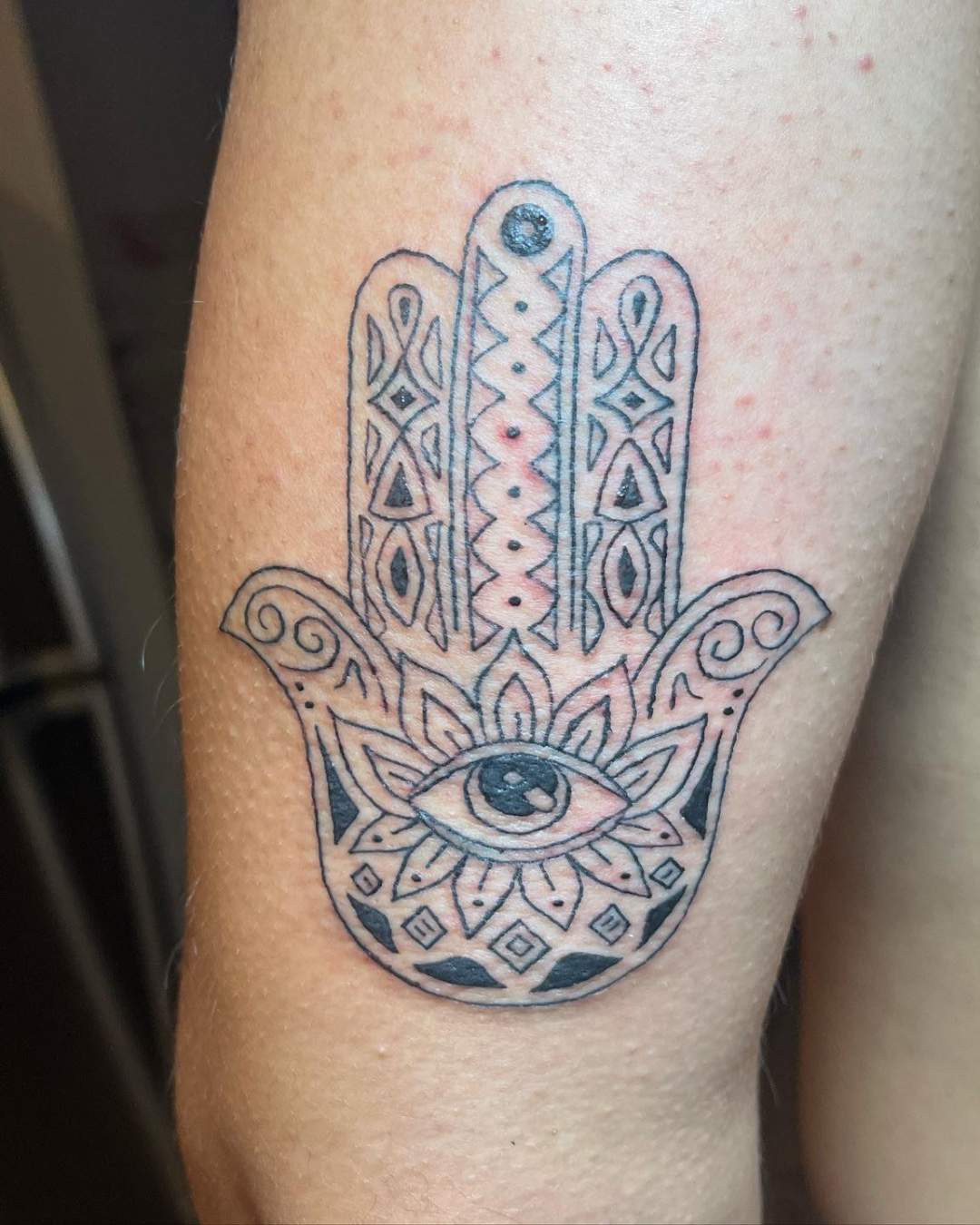
Berber tattoos, anywhere

Filters
1 tattoo artist
The Berber, or Amazigh, tattoo sets small geometric signs on the face, hands and ankles, speaking of protection, life stages and belonging.
On YokoFolio, pick the style Berber and then your city, and widen the radius: few artists really practice it. Look for someone who knows the meaning of the signs and not only their shape — that's the difference between an Amazigh tattoo and a geometric design. In the portfolio, look for small signs drawn with straight, even lines, dots of the same size and true symmetry; on healed photos of hands and fingers, the signs should still be crisp. If they ask where your interest comes from and what you want to say, that's a good sign. Ask which region the signs they offer come from. Before you wear a sign, have its meaning confirmed by people from the culture.
They're signs of protection, fertility, mourning and belonging: diamonds, chevrons, crosses, dots, zigzags, fish and palm motifs. The diamond often points to protection against the evil eye, the vertical lines on the chin to entering adulthood. Meanings vary from one region and one valley to another: Amazigh tattooing is a set of regional traditions, not a single system. The motifs of the Moroccan Atlas, those of the Algerian Aurès and those of southern Tunisia share a geometric vocabulary but not the same arrangements or the same placements, and the same sign can say different things. Much of what circulates online is simplified or invented: fieldwork and what families have kept are the only reliable sources. If you want to wear a motif from a specific region, ask people from that region rather than working from a generic sheet.
Overwhelmingly by women, and that's an essential part of its history: the tattoo marked the stages of a life — puberty, marriage, motherhood, widowhood — and went on the chin, the forehead, between the eyebrows, on the hands and on the ankles. Men wore them too, more rarely and on other areas. The practice fell off sharply in the 20th century, and many of the older women who wear it today speak about it with mixed feelings. That history calls for tact: the signs on a grandmother's chin or hands told her own life, and they deserve to be asked about before they're copied.
Berber work is made of small, separate geometric signs — a diamond, a chevron, a cross, a column of dots — set at precise points: the chin, the forehead, between the eyebrows, the hands, the ankles, with bare skin all around. Each sign stands on its own, in thin dark lines. Yoruba work builds pattern rather than single signs: repeats taken from adire cloth, groups of short parallel lines that echo facial marks, dotted fields, and figurative elements such as a Gelede mask or an orisha symbol. Both use chevrons and dots, so look at the arrangement: scattered signs in sets point to Berber, a repeating field or a mask to Yoruba. If the design is a set of small geometric signs placed like marks on the face, hands or ankles, it's Berber.